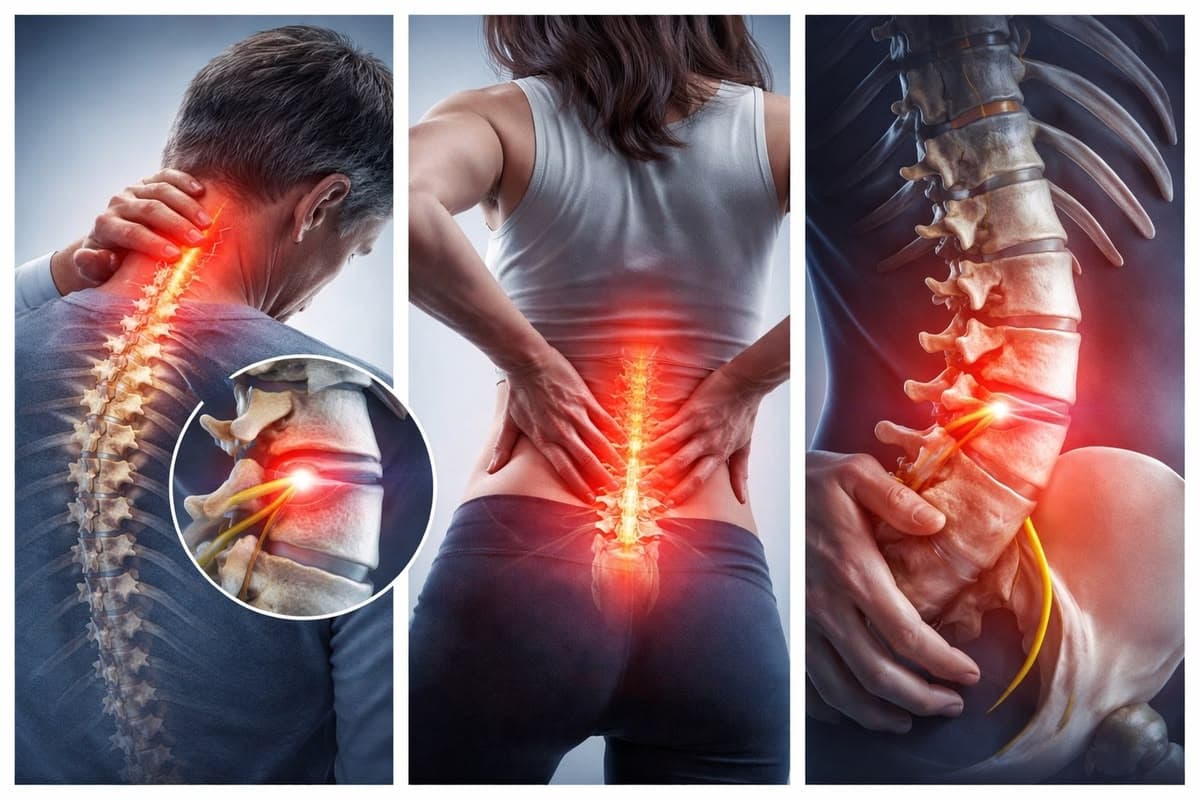
Slipped Disc (Herniated Disc): Physiotherapy vs. Surgery
AK
Dr. Arbaz Khan
Physio Team · Rawalpindi
October 1, 2026
18 min read
Recovery
Recovery
M
Mediplex Health Care Centre
Rawalpindi · Physiotherapy & Recovery
Your back has been aching for weeks. Now there is a sharp, electric pain running down your leg. Your MRI says "herniated disc," and someone has already told you that you "need an operation."
Take a breath. Most people with a slipped disc do not need surgery.
This guide explains what a slipped disc really is, how physiotherapy and surgery compare, and how to decide which route fits your situation. It also covers the emergency signs that should never wait.
Physiotherapy or Surgery for a Slipped Disc?
For most people, physiotherapy comes first. Most slipped discs improve within 6 to 12 weeks with structured conservative care. Surgery is usually considered when severe leg pain persists despite proper treatment, or immediately when there is progressive weakness or loss of bladder or bowel control.
That is the short version. The rest of this article explains why, and how to make the choice with confidence.
What Is a Slipped Disc? (Plain-Language Explanation)
Your spine is a stack of bones called vertebrae. Between each pair sits a soft cushion called an intervertebral disc.
Real reviews from real patients on our Google profile.
Google review
“Great physiotherapy experience! The staff was caring, professional, and supportive. I felt comfortable throughout and noticed genuine improvement after treatment.”
Emaan Rafaqat
2 weeks ago
Limited same-day slots
Ready to book an appointment?
Whether you're recovering from an injury or just want to move without pain. We're here.
Annulus fibrosus: a tough outer ring, like the wall of a tyre
Nucleus pulposus: a soft, jelly-like centre that absorbs shock
When the outer ring weakens or tears, the jelly centre pushes outward. That is what people call a slipped disc, herniated disc, or prolapsed disc.
One important point: the disc does not actually "slip." It bulges or leaks. The name is a bit misleading, but it stuck.
If that bulge presses on a nearby spinal nerve, you feel pain, tingling, numbness or weakness. The NHS overview of a slipped disc describes it the same way.
Bulging Disc vs. Herniated Disc: What Is the Difference?
People often use these terms interchangeably, but they describe different stages.
Disc bulge: the disc sticks out slightly, but the outer ring is still intact
Disc protrusion: the jelly pushes through a weakened area of the ring
Disc extrusion: the jelly breaks through the outer ring completely
Disc sequestration: a fragment breaks off and sits free in the spinal canal
A bulging disc is often painless. A herniated disc is more likely to irritate a nerve, though even that is not guaranteed.
Where Do Slipped Discs Happen?
Most occur in the lumbar spine (lower back), especially at the L4-L5 and L5-S1 levels. These segments carry the most body weight and move the most.
They can also occur in the cervical spine (neck), causing neck pain with arm numbness. A cervical disc herniation behaves differently from a lumbar one, and your therapist will assess it differently. Thoracic (mid-back) herniations are rare.
Why Slipped Disc Matters in Pakistan, Islamabad and Rawalpindi
Back pain is one of the most common reasons adults seek care worldwide. In Pakistan, daily life adds extra strain on the spine.
Here is what we see often in Islamabad and Rawalpindi:
Long desk hours: IT professionals, bankers and government employees often sit for 8 to 10 hours with poor posture
Long commutes: traffic between Rawalpindi, Islamabad and the sectors means hours in a car or on a motorbike
Heavy lifting without technique: from construction work to carrying luggage and groceries up stairs
Low physical activity: weak core muscles leave the spine under-supported
Delayed care: many people try home remedies, local massage or painkillers for months before seeking assessment
Cold winters also tighten muscles. That can make existing back and leg pain feel worse.
Diagnosis starts with a conversation and a physical exam. A trained clinician checks your movement, reflexes, muscle strength and sensation. They may also do tests like the straight leg raise to see whether nerve tension reproduces your pain.
An MRI scan of the spine is not always needed straight away. It is usually considered when:
Symptoms are severe or getting worse
There are signs of nerve damage
Pain has lasted beyond 6 to 12 weeks
Surgery or an injection is being considered
Why a Scan Alone Can Mislead You
This surprises many patients. Research shows that a large share of adults with no back pain at all have disc bulges or herniations on MRI. Depending on age, it can be roughly 30% or more of pain-free people.
So an MRI finding is not a diagnosis by itself. Treatment should follow your symptoms and examination, not just the picture.
"Treat the patient, not the scan." This is one of the most important ideas in spine care.
Can a Slipped Disc Heal Without Surgery?
Yes. In most cases it can.
The body has a built-in repair response. When disc material leaks out, the immune system recognises it as foreign. Immune cells called macrophages gradually break it down, and the fragment shrinks. This is called spontaneous resorption.
Studies suggest larger, more extruded fragments often shrink the most. That is why some severe-looking MRIs improve a lot over a few months.
Commonly quoted figures say that the large majority of people with sciatica from a herniated disc improve without surgery, often within 6 to 12 weeks. The exact percentage varies by study. The pattern is consistent, though: time plus smart conservative care helps most people.
Physiotherapy is not just "some exercises." A good programme is built around your exact symptoms. Here is what it typically includes.
1. Detailed Assessment
Your physiotherapist identifies which movements ease your pain and which provoke it. This guides everything that follows.
2. Centralization and Directional Preference (McKenzie Method)
The McKenzie method (Mechanical Diagnosis and Therapy) looks for a movement direction that reduces your symptoms.
For many people with lumbar herniation, repeated gentle back-extension movements help. The key sign is centralization: leg pain retreats from the foot or calf toward the lower back.
This is a good sign. It suggests the nerve is getting relief. Your therapist will guide this, because the wrong movement can make some people worse.
3. Core Stabilization
Deep muscles like the transverse abdominis and multifidus act like an internal corset around your spine. Strengthening them helps share the load, so your disc is not doing all the work.
This is the part that protects you long term, not just during the flare-up.
4. Nerve Gliding (Nerve Flossing)
Gentle movements help the irritated nerve slide more freely. This can reduce stiffness and sensitivity around the nerve root.
5. Hands-On and Supportive Therapies
Depending on your findings, treatment may also include:
Manual therapy to ease stiff joints and tight muscles
Traction or spinal decompression therapy in selected patients
TENS therapy for short-term pain relief
Dry needling for painful muscle knots
Heat and cold therapy for flare-ups
Not every technique suits every patient. A personalised plan matters more than a long list of machines.
6. Medication and Injections as a Bridge
A doctor may prescribe short-term anti-inflammatory medicines or muscle relaxants for severe pain. In some cases, a specialist may suggest an epidural steroid injection to calm intense nerve inflammation.
Think of these as a bridge, not a cure. They can reduce pain enough for you to move and rehabilitate properly. Medication decisions always belong to your doctor.
How Long Does Physiotherapy Take for a Slipped Disc?
Every person is different, but a common pattern looks like this:
Weeks 6–12: strengthening, return to daily activities and work
Beyond 12 weeks: reassessment, plus long-term prevention
Many people feel clearly better within 6 to 12 weeks. Some need longer. Your therapist will track your progress and tell you honestly if it is not working.
Option B: Surgery for a Herniated Disc
Surgery has a real place in spine care. It is just not the first step for most people.
What Is Microdiscectomy?
Microdiscectomy is the most common operation for a lumbar herniated disc. A surgeon makes a small incision, uses magnification, and removes only the piece of disc pressing on the nerve.
Related options include:
Endoscopic discectomy: an even smaller, camera-guided approach
Laminotomy or laminectomy: removing a small part of bone to make space for the nerve
Spinal fusion or artificial disc replacement: reserved for selected cases, such as instability
Benefits of Surgery
Faster leg pain relief: many patients feel better within days or weeks
Useful when pain is disabling: and nothing else has worked
Corrects pressure on the nerve: when weakness is progressing
Risks and Limits of Surgery
Every operation carries risk. Honest information helps you decide:
Re-herniation: the disc can herniate again at the same level. Estimates are often quoted at around 5 to 15%
Infection, bleeding or nerve irritation: uncommon but possible
Scar tissue around the nerve: can sometimes cause lingering symptoms
Back pain may remain: surgery mainly treats nerve-related leg pain, not general disc wear
Anaesthesia risks: as with any operation
Surgery removes the pressure on the nerve. It does not remove the reasons the disc herniated in the first place. That is why rehabilitation after surgery matters so much. Our post-surgical rehab service and post-operative rehabilitation care are built for exactly that stage.
Physiotherapy vs. Surgery: What Does the Research Show?
The best-known study is the Spine Patient Outcomes Research Trial (SPORT). It compared surgery with non-surgical care for patients with sciatica from a herniated disc.
Here is the honest picture in plain language:
Patients who had surgery generally improved faster
Many patients in the non-surgical group also improved substantially over time
Over one to two years, the gap between groups narrowed
Many people assigned to non-surgical care later chose surgery, and some assigned to surgery did not have it, which makes the results harder to read
So the fair conclusion is this:
Surgery tends to relieve severe leg pain sooner. For many people without emergency signs, outcomes after one to two years are similar to careful non-surgical care.
Guidance from bodies like NICE (NG59) on low back pain and sciatica supports staged, active management, with referral for specialist assessment when appropriate. Please use this as general background, not a substitute for your own clinician's advice.
How to Decide: Physiotherapy First, or Surgery?
Here is a simple way to think about it.
Physiotherapy is usually the right first step if:
Your symptoms started within the last 6 to 12 weeks
Pain is moderate and manageable
You have mild numbness or tingling but no real muscle weakness
You are improving, even slowly
You prefer to avoid operation risks
Surgery may be worth discussing if:
Severe leg pain continues beyond about 6 to 12 weeks of proper care
Pain is so intense you cannot work, sleep or function
Muscle weakness is getting worse
Scan findings match your symptoms clearly
You need quicker relief for important work or family reasons, after an informed discussion with a specialist
Both lists are guides, not rules. The right decision comes from an in-person assessment.
Red Flags: When a Slipped Disc Is an Emergency
Some symptoms should never wait for a physiotherapy course. Go to a hospital emergency department immediately if you have:
Loss of bladder or bowel control, or trouble passing urine
Numbness in the groin, genitals or inner thighs (saddle numbness)
Weakness or numbness in both legs
Sudden or rapidly worsening leg weakness, such as a dropping foot
Severe back pain with fever, unexplained weight loss or recent major injury
These may point to cauda equina syndrome, where nerves at the base of the spine are badly compressed. It needs urgent surgical assessment, typically within 24 to 48 hours.
Do not wait and see. Do not book a routine appointment first. Go straight to emergency care.
A Typical Patient Journey (Illustrative Example)
This is an illustrative scenario, not a real patient.
Imagine a 38-year-old software engineer from Islamabad who sits for most of his day. He bends to lift a heavy bag, feels a sharp pull in his lower back, and within two days has burning pain down his left leg.
An MRI shows an L5-S1 disc herniation. A friend advises surgery. Instead, he gets a full physiotherapy assessment.
His therapist finds that repeated extension movements move his leg pain upward toward the back. That is a good sign. His plan includes:
Pain-calming positions and short walks
Directional exercises
Core activation and nerve gliding
Workstation changes and sitting breaks
Over the next two months his leg pain fades, his strength returns, and he is back at work comfortably. Had he developed foot weakness or bladder changes, the plan would have changed immediately to urgent specialist referral.
Not every story ends like this. But it is a very common one.
What to Do at Home While You Recover
Home care supports professional treatment. It does not replace it.
Helpful habits:
Keep moving gently. Short, frequent walks usually help more than lying still
Avoid long bed rest. A day or two of comfort is fine, but prolonged rest tends to slow recovery
Change positions often. Do not sit for more than 30 to 40 minutes at a time
Use heat or cold for comfort, whichever feels better
Sleep smart. Try lying on your side with a pillow between the knees, or on your back with a pillow under the knees
Lift properly. Bend your knees, keep the load close, and avoid twisting
Movements to be careful with during a flare-up:
Deep forward bending and toe touches
Heavy squats or deadlifts
Loaded twisting
Sit-ups and leg raises
Is yoga safe? Gentle, supervised movement can help some people, but some poses involve deep flexion or twisting that may aggravate a disc. Ask your therapist before starting.
A disc that has herniated once can herniate again. Prevention is about building a stronger, more resilient back.
Strengthen your core with guided exercises, not just crunches
Move regularly. Stand, stretch and walk during long sitting hours
Fix your workstation. Screen at eye level, feet flat, lower back supported
Lift with your legs, not your spine
Stay at a healthy weight
Stop smoking. It affects disc health
Stay active with walking, swimming or other low-impact exercise
Address pain early, before it becomes a long-term pattern
A little consistency each day does more than a big effort once in a while.
Frequently Asked Questions About Slipped Disc Treatment
What is a slipped disc?
A slipped disc is when the soft centre of a spinal disc pushes through its tougher outer ring. It may press on a nearby nerve and cause back pain, leg pain, tingling or weakness. Doctors also call it a herniated or prolapsed disc.
Can a slipped disc heal without surgery?
Yes, in most cases. The body can gradually shrink leaking disc material, and most people improve within weeks to a few months with active conservative care. Surgery is usually reserved for severe, persistent or worsening cases.
How long does a slipped disc take to heal with physiotherapy?
Many people notice clear improvement within 6 to 12 weeks. Some recover sooner and some need longer, depending on severity, age, general health and consistency with exercise.
When should I choose surgery for a slipped disc?
Consider specialist assessment if severe leg pain persists after proper non-surgical care, or if weakness is worsening. Emergency surgery may be needed for bladder or bowel problems, saddle numbness or rapidly progressing weakness.
Is surgery for a slipped disc safe?
Microdiscectomy is a common operation and generally has good outcomes in suitable patients. Like any surgery, it carries risks, including infection, nerve irritation and re-herniation. A specialist can explain your personal risk.
Can a slipped disc come back after treatment?
Yes, it can, after either physiotherapy or surgery. Core strengthening, good posture, safe lifting and regular activity lower that risk.
Is bed rest good for a slipped disc?
Not for long. A short rest during severe pain is fine, but staying active within comfort usually leads to better recovery than prolonged rest.
Can walking help a slipped disc?
For many people, yes. Gentle walking keeps the spine moving and supports healing. If walking sharply increases leg pain or weakness, stop and get assessed.
Which exercises should I avoid with a herniated disc?
During a flare-up, be careful with deep forward bends, heavy lifting, loaded twisting and sit-ups. Always ask your physiotherapist before starting a new exercise.
Does a herniated disc always need an MRI?
No. Many people are diagnosed and treated based on symptoms and examination. An MRI is mainly useful if symptoms are severe, worsening, or if surgery or an injection is being considered.
Which doctor should I see for a slipped disc?
Start with a physiotherapist or your family doctor. Depending on your findings, you may be referred to an orthopedic surgeon, neurosurgeon or spine specialist.
Can a slipped disc cause paralysis?
This is rare. But severe nerve compression can cause serious weakness or loss of bladder or bowel control, which is a medical emergency. Seek urgent care if you notice these signs.
Can physiotherapy replace surgery for a slipped disc?
For many people, yes. Most slipped discs improve with physiotherapy and time. But not everyone: emergencies and cases with worsening weakness or unmanageable pain may need surgery.
Final Thoughts: Choosing the Right Path With Confidence
A slipped disc sounds frightening, but it is usually manageable. For most people, physiotherapy is a sensible first step, because the body often heals the disc on its own with the right support. Surgery remains an important option for those with severe, persistent pain or red-flag symptoms.
The best choice is the one based on your symptoms, your examination and your goals, not on a scan alone or on fear.
If you are dealing with back pain, leg pain, numbness or tingling, book an assessment with Mediplex Physiotherapy in Islamabad or Rawalpindi, including home-visit options, and get a personalised recovery plan. You can contact Mediplex here to get started.
AK
Dr. Arbaz Khan
Mediplex Health Care Centre, Rawalpindi
Share:
Mediplex Team
Google review
“Good Physiotherapy clinic. The pain was gone in prescribed time.”
Afnan Afrose
3 weeks ago
Pain gone in prescribed time
Google review
“I was suffering from frozen shoulder then I searched on Google I came to know about Dr Arbaz Khan I visited Mediplex and within 4 sessions my pain reduced by 50 percent. I highly recommend Dr Arbaz and Mediplex physiotherapy clinic.”
HANZO FF (Free fire king)
Frozen Shoulder · 5 weeks ago
Pain reduced by 50% in 4 sessions
Google review
“I've came to know about Mediplex physiotherapy clinic on Google then I visited Dr Arbaz for my postural issue, after thorough assessment Dr Arbaz made a plan for my treatment and alhamdulillah after few sessions my body feels very light.”
Hammad Shinwari
Postural Issue · 6 weeks ago
Body feels light after a few sessions
Google review
“Dr M Ashar Rafi excellent doc recommended.”
Danish Khan
7 weeks ago
Google review
“I had severe back pain after taking session at Mediplex physiotherapist clinic I fee so much better the pain management here is amazing highly recommended.”
Kiran Javed
Severe Back Pain · 7 weeks ago
So much better after treatment
Google review
“Good care given by Dr. Amna. Neat and clean environment and good professional conduct by the staff.”
Seher Osman
16 weeks ago
Google review
“I had a great experience at Mediplex Physiotherapist Clinic. I went in with a shoulder injury from bad posture and left with way less pain and a clear plan to keep it from coming back. The physio took time to assess everything, explained the cause in simple terms, and tailored the exercises to my routine. Appointments were on time, the clinic is clean and well-equipped, and the staff at the front desk were really welcoming. If you want a clinic that focuses on fixing the root issue instead of just quick fixes, this is the place.”
Nirmal Warris
Shoulder Injury · 19 weeks ago
Way less pain and a plan to prevent recurrence
Google review
“Exceptional experience at Mediplex Physiotherapy Clinic. The team is highly skilled, professional, and genuinely cares about patients' recovery. From assessment to treatment, everything was handled with great attention and expertise. The clinic environment is clean, comfortable, and very well managed. I noticed real improvement in a short time. Highly recommended for anyone looking for quality physiotherapy care.”
Ayesha Khan
19 weeks ago
Google review
“Attitude of the people there in Mediplex is very nice. Overall I am satisfied with the sessions I received there.”
Nasreen Ahmed
19 weeks ago
Google review
“I was suffering from muscular pain then I visit to Dr Arbaz he specialized treatment helped me a lot in my work now I am almost pain free. Thanks to Allah i am now living healthy life once again.”
Kamran Abbasi
Muscular Pain · 18 weeks ago
Almost pain free now
Google review
“Mediplex Physiotherapy Clinic provides professional and caring physiotherapy services with a friendly environment. The staff is cooperative, and the treatment helps patients recover comfortably and effectively.”

 Recovery